
The instrument stands on its endpin. Why are you holding it up? The floor is already doing that job.
Your endpin carries the instrument's weight into the floor, and the floor carries yours as well. Somewhere between the two, your back leans in, your left thumb presses into the neck and your bow arm pushes down into the string, and by the second hour of rehearsal you feel all three. That extra work switches on at particular moments, when your attention shrinks to the fingerboard and you stop feeling the floor, the instrument and the rest of yourself.
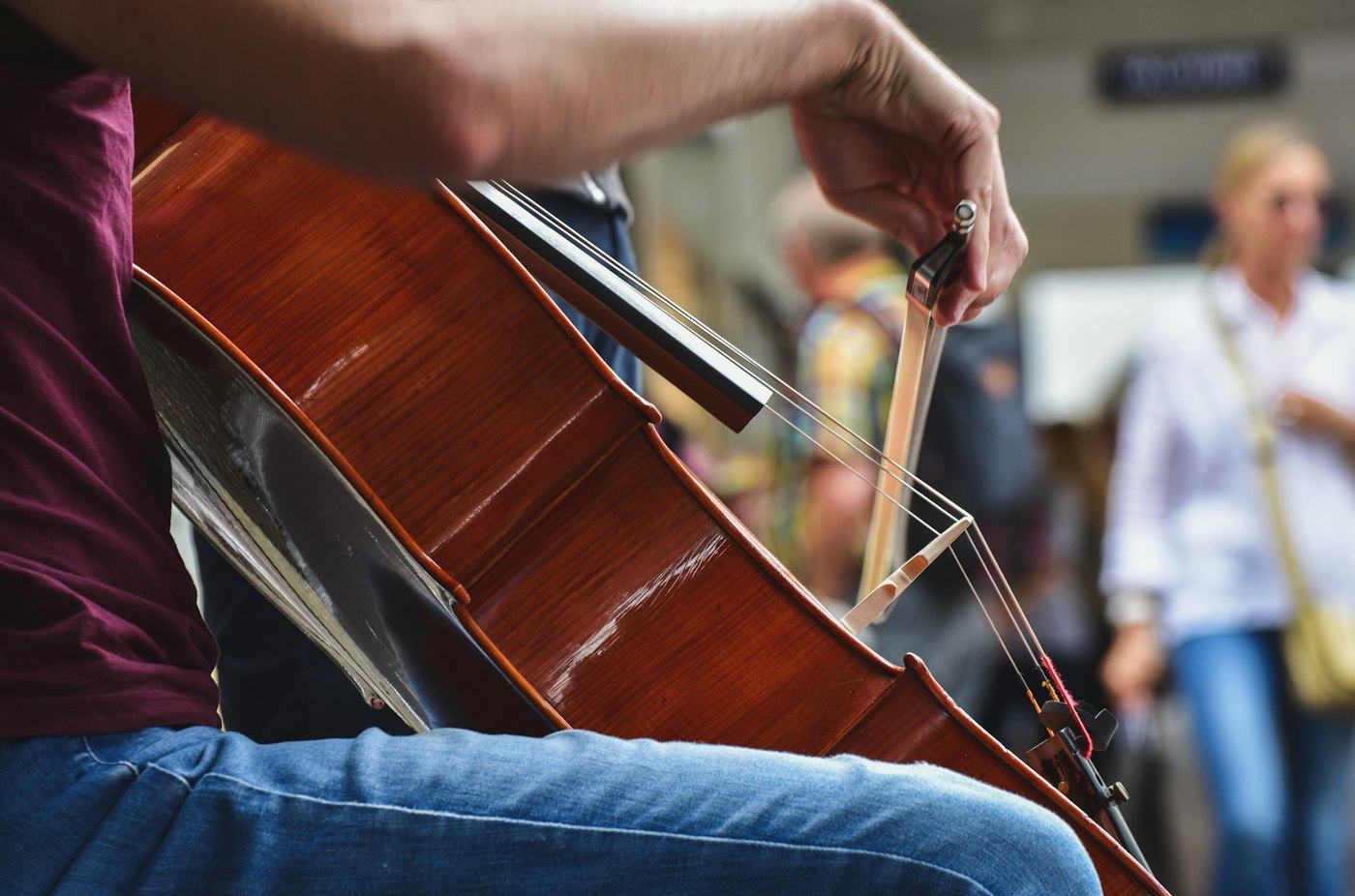
Photo: Manny Becerra on Unsplash
The second hour of rehearsal
Cello and bass ask for size. Your left arm travels farther, your bow has more string to cover, and in thumb position you lean over the instrument to see where you're going. None of that is wrong, per se, but it's easy to add a little extra effort to each of those motions and keep it there after the motion is finished.
You know the gear answers already: a longer endpin, a bent one, a rock stop so the spike can't slide, a wedge cushion, and for bassists a taller stool, a shorter one, a year of standing and then sitting again. Some of them helped for a week. The ache between your shoulder blades came back anyway, because none of them changed what you do the moment a hard passage appears on the stand.
Where cellists and bassists feel it
Thumb position
When your thumb goes up across the strings and your hand opens, your whole arm wants to press down to make the high notes speak. Your head and back lean in at the same moment so you can see, and your neck ends up paying for the upper register.
Extensions and shifts
Your left hand squeezes hardest when it's stretched, in the extended positions and on a long shift across half the fingerboard. Your thumb behind the neck presses forward against your fingers, and the squeeze stays on through notes that never needed it.
Your bow arm
String players are told to use arm weight, so you sink a heavy arm into the C string. Let that much weight drop and the sound turns to gravel, you fight the gravel, and now you have two tensions instead of one.
The double bass
Standing, the bass leans into your body while your left arm reaches up and out for the lower positions, and seated, the height of your stool decides how far your back curls. The notes sit so far apart that a whole step can fill your hand, which teaches your hand to stay spread and tense. If you play jazz, you add hours of pizzicato on top of all that.
What you stop feeling when the passage gets hard
The usual advice sends you to the part that hurts: stretch your back, strengthen your thumb, move the endpin another half inch. Each one treats tension as a “where” problem, when it's really a “when” problem. Notice what happens as you approach a hard run: your eyes find the thumb-position passage on the next line, and your hand and back start tightening a full bar early.
In that bar of tightening, your attention narrows to your left hand and the rest of you drops out of your awareness, and you can't release tension you can't feel. What I call “Sensing Instead of Doing” brings the rest of you back. Instead of treating your cello as a tool you act on, you treat it as a sensing tool: you feel its whole size, weight and shape as you play, and you notice the space that opens up around it. Then you add the ground, sensed rather than imagined, not just under your feet but all the way through the neighborhood.
Gravity pulls you into the floor without your doing anything, and your endpin passes the instrument's weight into the same floor. When you feel that while you play, the floor goes back to doing the job it was doing all along.
Feel the instrument, the floor and yourself
Sit at the cello, or sit or stand at the bass, and choose a passage that tightens you: a thumb-position run, a long shift, an extension. Give your back, left hand and bow arm one tension number, 0 to 10.
- Play the passage once as you normally would, then ask which parts of your body you forgot while you played. Write down your number.
- Play it again sensing your whole body the entire time, the forgotten parts included.
- Play it a third time treating your cello or bass as a sensing tool rather than a doing tool: feel its whole size, weight and shape as you play, and notice the space that opens up around it.
- Play it once more sensing the ground, not just under your feet and your endpin but all the way through the neighborhood. Rate the same places again and ask the “golden question”: tighter or freer?
With five or ten more minutes, start the full version lying on the floor in constructive rest, noticing how gravity pulls you into it without your doing anything, then roll to your side, come up and play. If the passage fell apart, slow it down; sensing everything at once is a skill, and the first try feels like patting your head while rubbing your stomach.
Want one of these every day for five days? Start the free 5-Day Tension Reset.
“Joseph helped me understand the anatomy and psychology of effortless playing. His lessons are well thought-out, entertaining, and insightful.”
Learn to play cello and bass more freely, every week
In the Soulforce Studio I teach a short lesson each week, lead group exercises that everyone plays along with at home, give one-on-one help to a few musicians who volunteer, and then open it up for questions. In a single session, the 0 to 10 number I hear from players usually falls from around 7 to around 4. It runs on Zoom, alternating between Saturdays at noon and Monday evenings at 7:30 Eastern, for $99 a month with no contract.
Who this isn't for
- Players who want an endpin length or stool height prescribed for them. Setup comes up, but the work is on what you do once you're sitting or standing.
- Anyone with a diagnosed injury, numbness, or pain that sharpens from week to week. Get medical care first; what I teach is education, alongside treatment rather than in place of it.
Your questions, answered.
Rather talk it through first? You can book a free 20-minute call with me.