
Three hours sitting up straight. Your back is filing a grievance. It turns out a good slump is part of the fix.
You sit tall at the first downbeat the way a serious player should, and by the second hour your lower back aches, your neck has crept toward the stand, and the hardest passage on the program is still forty minutes away. This page is for section players of every kind, from professionals paid by the service to community players rehearsing after work.
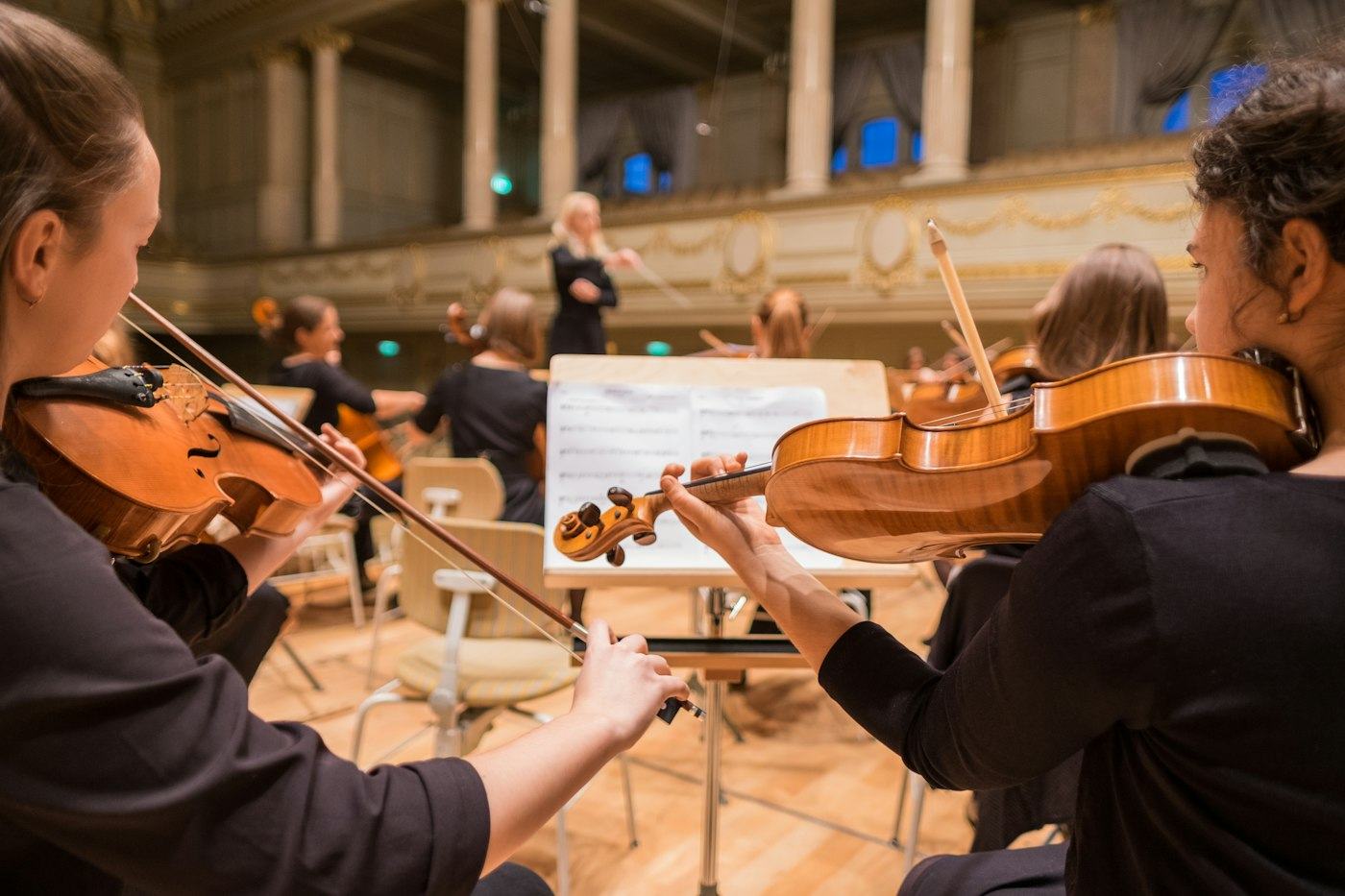
Photo: Larisa Birta on Unsplash
Sitting two feet from the people who would notice
An orchestra is a hard place to carry a tension habit, because nobody can see the habit but everyone can hear what it does to your playing. You sit for hours counting long rests in which your only job is to hold yourself up and wait for your entrance, and when the exposed solo or the soli line arrives late in the evening, the whole section hears what those hours did to your breath and shoulders.
You've gotten good at hiding it: you shake out a hand under the stand during the tacet movement, you make a joke about the cold hall, and you spend another evening at home practicing a passage you already know. Meanwhile, at every rehearsal, part of your attention goes to managing what the principal would notice, and that attention comes straight out of your listening.
In a community orchestra the stakes look smaller from the audience but feel no smaller from your chair. Nobody pays you to be there, so when the ache starts following you home from rehearsal, the easy thing is to miss a week, then a whole concert cycle, and slowly lose the one evening a week when you and a whole orchestra breathe in on the same upbeat.
What your stand partner doesn't see
Three hours in a chair
A double service, a dress rehearsal that runs long, a community rehearsal after a day at a desk. You start out sitting upright and proud, you sag by the first break, you haul yourself up again, and you spend the rest of the evening swinging between the two.
The bar before your solo
The tightening starts in the bar before your entrance. While you count toward the horn call or the oboe line in the slow movement, you spend that last bar tightening: you stop breathing, set your jaw and stiffen your spine, so you play the first note from a body that's already working hard.
Your stand partner and the principal
String players share a stand with someone close enough to see their bow shake, and winds and brass sit where the principal hears every attack. Making sure nothing shows takes a small extra squeeze, and that squeeze is what shows.
Why “sit up straight” gives out before the Brahms does
The usual fixes treat this as a “where” problem: a cushion for your lower back, a stretch on the break, a new shoulder rest, and the childhood instruction to sit up straight with your shoulders back. Try that last one now and ask yourself the “golden question”: tighter or freer? Sitting up straight moves you in the right direction, which is up, but with the wrong quality, which is tight.
Every posture has a direction, up or down, and a quality, tight or free, and a single thought can set both. In what I call “Four Thoughts, Four Bodies,” the thought “I have to do it fast and I have to get it right” sits you up like a soldier, tight and up. “Oh no, I hope I don't mess up” pulls you in like a turtle, tight and down, and “I can't do it, I give up” drops you into a slump, free and down. The fourth combination, free and up, is what I call relaxing up, and its thought is “I'm at ease with myself and I have plenty of time.” Two hours into a rehearsal, part of you wants to go down because you're tired while another part insists that you stay up and keep counting, and the strain you feel by the last hour is those two parts fighting.
That fight builds the longer you sit, which makes this a “when” problem as much as a posture problem. The thought you hold in the bar before your entrance decides whether you play that entrance as the soldier, the turtle, the slump or relaxed up, and on the long rests the “Super Slump” ends the fight for a minute. I've taught for more than twenty years, and the change I see most in a single session is a self-rated tension of about 7 coming down to about 4.
Play it as a soldier, a turtle, a slump, and then as yourself
You'll need your instrument, a chair like the one at rehearsal, and a short passage from your part that gives you trouble. Rate the tension in your back, neck and shoulders from 0 to 10, then play the passage four times, holding a different thought each time.
- The soldier. Think, “I have to do it fast and I have to get it right,” and play the passage. What do you notice? Are you getting tighter or freer, and going up or down?
- The turtle. Think, “Oh no, I hope I don't mess up,” and play it again. Ask the same questions: what you notice, tighter or freer, up or down.
- The slump. Think, “I can't do it, I give up,” and play it once more. Notice what happens to your back, your sound and your sense of the room around you.
- Relaxing up. Think, “I'm at ease with myself and I have plenty of time,” and play it a last time. Tighter or freer, up or down? Then rate your tension again from 0 to 10.
If the last version felt freer, take that thought with you into the third hour of rehearsal; even believing it one percent is one percent better. For the long rests and the break, add the “Super Slump”: let your whole body agree to go down, stay there until a breath or a feeling of relief arrives, then get curious about the space around you and let that curiosity bring you back up. On stage you won't slump all the way down, but you can slump a little and still get the reset.
Want one of these every day for five days? Start the free 5-Day Tension Reset.
“I first came to Joseph for tension that had crept into my left arm while playing violin — it had started to get in the way in performances. He’s an experienced Alexander Technique teacher who comes from a musician’s background, and he gave me a much more detailed awareness of how my body is interconnected. Playing feels significantly better now, and sustainable over long periods.”
Bring your hardest passage to the Studio
In the Soulforce Studio you learn to play more freely, every week. We meet live on Zoom, alternating between Saturdays at noon and Mondays at 7:30 PM Eastern, and each class combines a short lesson, group exercises everyone plays along with, one-on-one help for a few musicians who volunteer, and time for questions. It's $99 a month, and you can cancel whenever you like.
Who this isn't for
- Players with an injury that needs a diagnosis. This is education in how you use yourself while you play, and new numbness, swelling or sharp pain belongs with a doctor first.
- Anyone looking only for gear advice: the right chin rest, cushion or endpin.
Your questions, answered.
Rather talk it through first? You can book a free 20-minute call with me.