
Your forearm plays octaves like it's in a fight with the piano The “Thing Mode” wins on points and loses the music.
You can play the octaves. The trouble is what your forearm does while you play them: it clenches, your wrist locks to hold the shape, and your shoulders climb toward your ears when the music gets loud. I'm a violinist, not a pianist, but twenty-plus years of teaching every kind of musician have shown me what sits under that clench: you're treating your hands as tools and the passage as an opponent to beat.
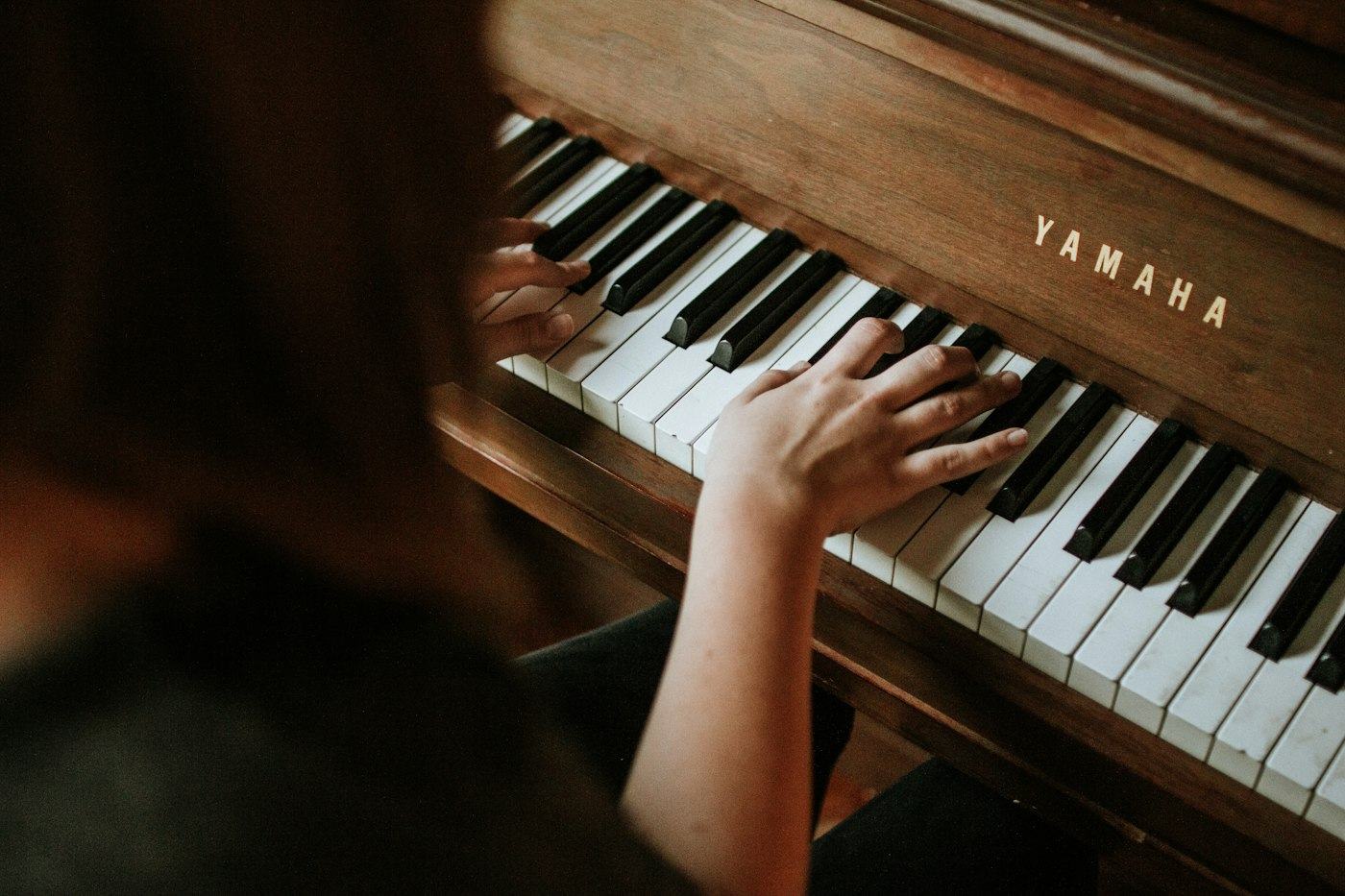
Photo: Gabriel Gurrola on Unsplash
Loud, fast and a little too big for your hand
You feel it at particular places in the score: the left-hand octaves in the A-flat Polonaise, the tenth you can't reach so you roll it, the last page of anything by Rachmaninoff. Afterward the top of your forearm burns and your wrist feels like it's been held in one shape for ten minutes, because it has.
You've tried the usual answers. You lowered the bench, raised it, slid it back an inch and stretched between pieces. If your hands are small, you've read about narrower keyboards and wondered whether your hand span is simply wrong for the music you love. Your span is real, but in my experience the pain comes from what your hand does to make up for it, and that part can change.
Where pianists feel it
Octaves
Your hand stretches open for the octave and stays stretched between octaves, so the muscles that opened it never get to let go. Your wrist locks to keep the shape, and your forearm carries the load.
Big chords and loud passages
Your shoulders lift and your arms keep pushing into the keys after they've already hit bottom, as if volume came from pressing. Your tone hardens, your forearms tire, and you start the next quiet passage still pushing.
Your thumb
Your thumb tucks under for scales and stays tucked, or it keeps pressing into a key long after the note has sounded. A tight thumb pulls on your whole hand, and your forearm feels it.
Sitting at the bench
Whatever the height and distance of your bench, the bigger cost is the “sit up straight” you were given at seven or eight: spine tall, shoulders level, chin lifted, held that way the whole time while your arms try to be free.
Treating your hands as things, or as beings
Treating your wrist as the problem makes sense, because that's where it burns, but that treats tension as a “where” problem when it's really a “when” problem. Watch what you do in the moment before a big chord: your eyes see the chord coming, your shoulders lift, you stop breathing, and your hand sets its shape a full beat before it's needed. By the time your fingers reach the keys, your wrist is already locked.
What drives that tightening is a way of paying attention I call “Thing Mode”: your hands become things to be manipulated and the passage becomes a problem to beat, so you fix every slip by force, over and over: execute, analyze, correct, repeat. “Thing Mode” has its place when you're figuring something out or solving a specific problem, but when it runs your playing, the music comes out mechanical, as if you were playing at the listener, or angry with the piano.
“Being Mode” regards the same hands, and the music, as beings to be honored. As I tell my students, if you respect your hands like that, they'll tell you what they're actually up for, and you'll be able to listen to them. An 80 to 90 percent drop in pain and tension over eight weeks is realistic, as it has been for many of my students.
Play the same passage in two modes
Sit at the piano with an octave or big-chord passage from your own music, and give your right wrist and forearm a number, from 0 for free to 10 for locked.
- Away from the keys, bring your hands up in front of your chest, palms facing, and tap your thumbs together, then your forefingers, then each finger in turn and back, quickly, regarding your hands as things to be manipulated: every fingertip must meet dead center, with no misses. Tighter or freer? More fun or less?
- Tap again, this time regarding your hands as beings to be honored; if that sounds abstract, say to yourself, “my well-being matters.” Did your fingers fall apart when you stopped controlling them?
- Play the passage in “Thing Mode,” as something to be manipulated: execute, control, don't miss. Rate your forearm.
- Play it again in “Being Mode,” as something to be honored: receive it, listen to it, allow it. Rate your forearm again and ask the “golden question”: tighter or freer? More fun or less?
The second version won't always sound polished yet, and that's okay. What to listen for first is whether it sounded less robotic and more alive, even if it wasn't perfect.
Want one of these every day for five days? Start the free 5-Day Tension Reset.
“As a professional choral director and pianist, I'd lived with chronic pain for two decades. Joseph's approach goes far beyond technique — a real connection between music, body, and soul.”
Learn to play piano more freely, every week
In each Soulforce Studio class I lead group exercises you follow along with at your own piano, so you can try every experiment on the spot, and a few musicians who volunteer get one-on-one help. Each class opens with a short lesson and ends with open Q&A. The Studio is $99 a month on Zoom, Saturday noon one week and Monday 7:30 PM Eastern the next, and you can leave whenever you choose.
Who this isn't for
- Pianists who want fingering or interpretation lessons. Keep those with your piano teacher; the Studio works on how you use your arms and body while you play whatever fingering you've chosen.
- Anyone with tendinitis, carpal tunnel symptoms or numbness that hasn't been looked at. Get a diagnosis first; this is education, not medical care.
Your questions, answered.
Rather talk it through first? You can book a free 20-minute call with me.